I Overengineered Crème Brûlée With Thermodynamics | The Science of a 1…



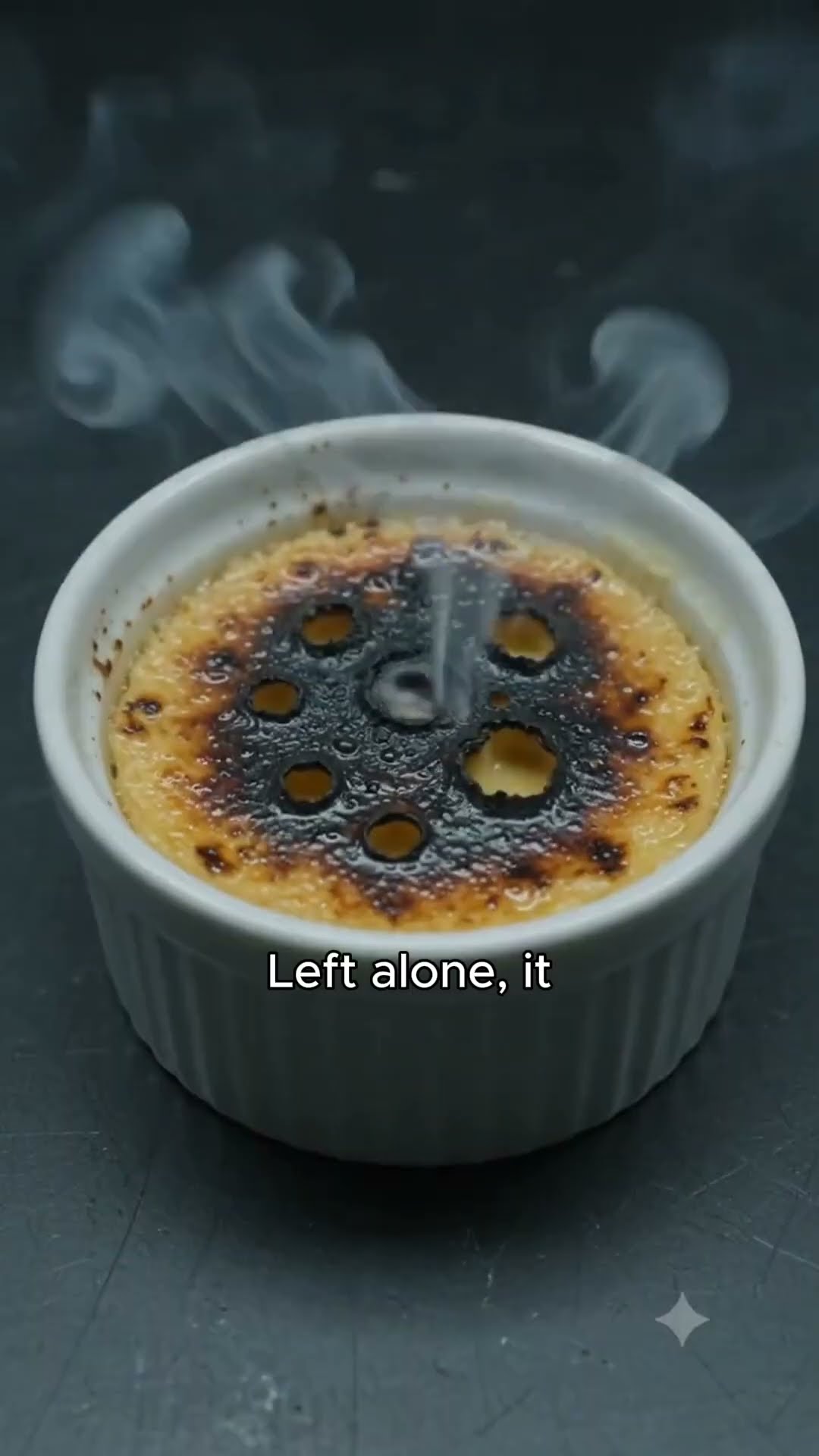
Why does the sugar crust on crème brûlée crack like glass?
This time, instead of treating crème brûlée as just another dessert, we analyzed it through sucrose pyrolysis, crystallization, heat transfer, and glass transition.
We start with a vanilla custard set at 82°C and cover the surface with a uniform layer of sugar approximately 0.3 millimeters thick.
Then comes the 1000°C blowtorch.
The moment intense heat reaches the surface, the sugar rapidly melts and begins to brown.
But concentrate that heat for too long, and the perfect caramelized crust quickly turns into a bitter, carbonized layer.
So the torch angle and working distance are carefully controlled.
Once the sugar reaches its molten state, rapid cooling suppresses crystal formation and locks the surface into a hard, amorphous amber sugar glass.
Then comes the final test.
A stainless-steel spoon strikes the surface, producing a sharp fracture and a network of radial cracks.
Soft custard underneath.
Brittle glass-like sugar on top.
All we really needed was custard and sugar.
But explaining that perfect crack required thermodynamics and material science.
Did we really need to take crème brûlée this seriously?
Probably not.
But we did it anyway.
Far more serious than necessary.
Surprisingly useful once you understand it.
Useless Cooking Science
Comments 0
No comments yet. Be the first!